

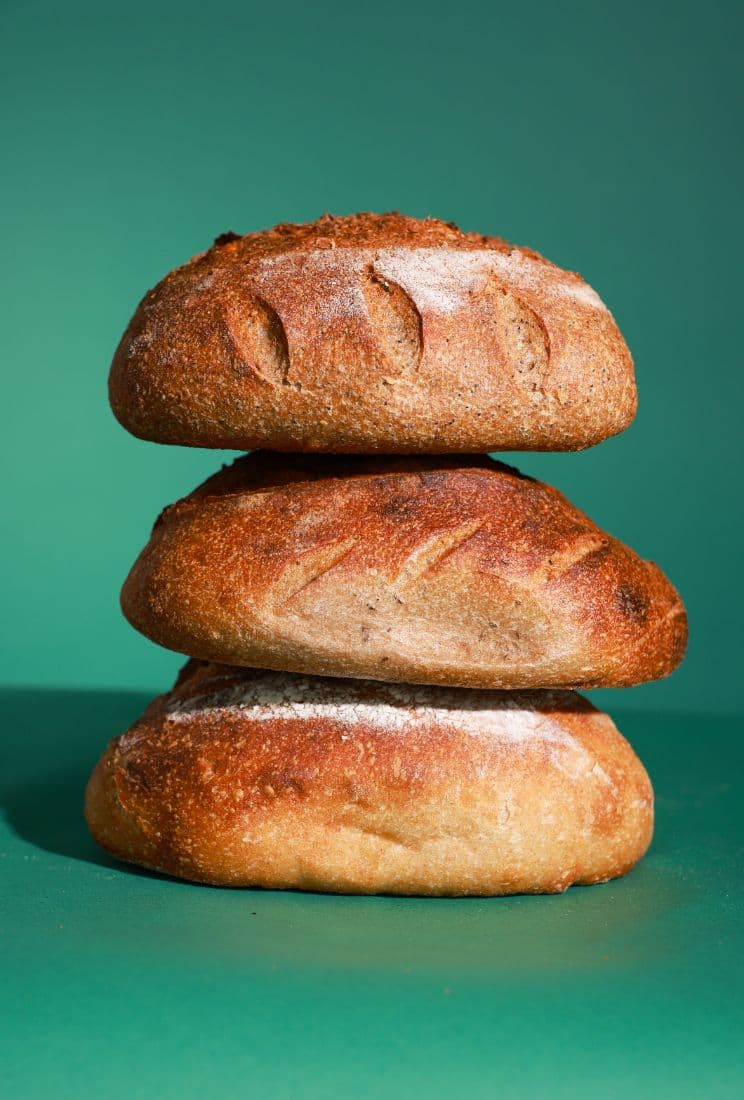
The Bake
Why We Ferment Our Sourdough for Days.
Four ingredients and a starter we have kept alive since 2018. The time is the part we cannot shorten — here is what it is for, and what to do with the loaf when you get it home.
Four Ingredients.
The company started with bread, and the bread starts with a list short enough to say out loud. “Organic flour, water, sea salt, and our eight-year-old starter. That is the whole list.”
There is no commercial yeast on that list, and that omission is the whole subject of this page. A naturally leavened loaf rises because the culture in the starter is alive and working, and a living culture works to its own schedule rather than ours. What that buys is flavor; what it costs is time, and the time is not compressible.
The Starter Is Eight Years Old.
ThoroughFare began in 2018 as ThoroughBread, a small Austin bakery — co-founder Ryan Goebel baking at home and selling to neighbors and at local farmers markets, before the first bakery opened that November. The starter dates from then. It has been carried forward ever since, through tens of thousands of loaves, which is why the ingredient list can name it as an ingredient rather than a step.
A starter is not a recipe you can write down and hand over. It is a population — the yeasts and bacteria that have settled into one bakery — and it is the reason two bakeries can follow the same method and produce two different breads.
What the Time Is For.
What we publish about the schedule is that these loaves are naturally fermented for days — a long, slow ferment, in the words the bakery counter uses. Nothing about that is a technique we invented; it is what a natural leaven requires if you let it do the work instead of pushing it along with something faster.
Two things happen while it sits. The culture produces the acids that make a sourdough taste like one — the tang, and the depth underneath it that a quick-risen loaf never develops. And the dough itself changes: the structure that gives a slice its open crumb and its chew builds slowly, under fermentation, not in the mixer.
None of that can be bought back later. A faster rise gives you a loaf on the same day; it does not give you the same loaf, and there is no stage further along where the flavor can be added instead. This is the one place in the shop where the ingredient list being four items long makes the process harder rather than easier — with nothing else in the dough, everything the bread will taste like has to come from the flour, the culture and the wait.
It is also why the loaves cannot be hurried when a Saturday is busier than expected. The loaves on the counter this morning were started days ago. Bread is the one thing in the shop where the planning has to happen days ahead, and it is the reason a sold-out loaf is genuinely sold out rather than fifteen minutes away.
One Method, More Than One Loaf.
The bakery calls the whole line the Sourdough Bread Project, which is the honest name for it: one method, applied to whatever grain the bakers are working with, and a shelf that grows. The white and the wheat are the constants. Anything else made the same way joins them automatically, because the shelf on the site is built from the catalog rather than from a list somebody remembers to update — a new sourdough is on the counter and on the site the same morning.
A loaf runs about a pound and a half, and it can leave the counter whole or cut. Whole keeps freshest, and slicing as you go is the advice on the counter. If you would rather have it cut, the thickness is a real decision rather than a preference: thin slices are built for sandwiches, and thicker ones hold up under butter, eggs, and gravity.
Shaped by Hand, Before the Sun.
At the end of the ferment the loaves are shaped and baked by hand, every morning, before the shop opens. The rest of the bakery holds to the same sourcing: only organic flours from Central Milling, milled from grain grown by farmers we know, all-organic fair-trade sugar and European-style butter.
Where the baking happens is worth stating plainly rather than romantically, because it is two places: at FareGrounds, our production facility in Palestine, Texas, and fresh in our store kitchens each day. If you want to see a bake, the shop in Mueller is the place to come and ask.
Keeping a Loaf Alive for Three Days.
Nothing in the loaf is there to keep it soft, so how you store it decides how long it stays good. Our own advice for it, unchanged from the loaf page:
The third day is not a failure state. A slice of three-day-old sourdough fried in butter is the best thing that happens to the loaf — which is also why whole and unsliced is one of the choices at the counter, since bread cut as you go keeps freshest.
- Cut-side down on the board for a day or two, or in a paper bag. Never the fridge. It stales bread faster.
- Run the crust under the tap for a second, then into a 350° oven for 6–8 minutes. It comes back like it was baked this morning.
- Sandwiches on the thin slice, toast on the thick. Torn next to soup. Fried in butter the third day.
Then It Becomes Lunch.
The loaves are not only sold as loaves. Every sandwich in the kitchen starts on sourdough baked that morning, cut thin for a sandwich or thick for toast that has to carry things, and the butter and jam on the market shelf were made to go on the same bread.

Where to See It
In the Shop.
The Loaves Themselves